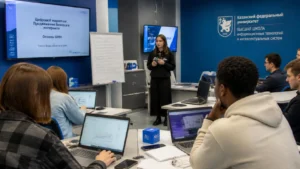
My First Semester Experience at Kazan Federal

Starting medical school abroad is exciting, but it also comes with countless questions. What is the learning environment really like? How difficult is the coursework? Can international students adapt quickly? These are common concerns, and the first semester often becomes the turning point that shapes both academic confidence and personal growth. Rather than being simply the beginning of an MBBS program, it is the foundation for every challenge and achievement that follows.
My First Semester Experience at Kazan Federal University completely changed my perspective on medical education. Every lecture, laboratory session, and discussion introduced new ways of thinking while gradually building the discipline needed to succeed. As educator John Dewey once said, “Education is not preparation for life, education is life itself.” That idea perfectly reflects how each day during the first semester became an opportunity to grow far beyond the classroom.
Understanding The KFU MBBS System During My First Semester Experience
Before diving into the details of each subject, it is worth understanding how Kazan Federal University structures its MBBS program. The Federal University Experience is designed to create a balanced learning environment where theoretical knowledge, laboratory practice, and critical thinking work together to build a strong medical foundation. From the very beginning, students are encouraged not only to understand medical concepts but also to apply them in practical situations, making the transition into medical school both challenging and rewarding.
My First Look At The MBBS Syllabus
When I first reviewed the MBBS syllabus, it looked challenging because of the number of subjects covered simultaneously. Anatomy, Histology, Biology, Medical Chemistry, and Latin terminology all required consistent attention. However, the curriculum followed a logical sequence that made each subject support the next, allowing knowledge to develop naturally.
The curriculum also reflected many current concepts found in modern medical education, including international medical education, student-centered learning, clinical reasoning, medical foundation courses, and problem-based learning, making the overall learning experience more relevant and engaging.
How Assessment Methods Worked
Assessment throughout the semester relied on continuous evaluation rather than a single final examination. Regular quizzes, laboratory assessments, oral examinations, and written tests encouraged students to stay prepared every week instead of studying only before exams.
This system initially felt demanding, but it gradually built confidence because every assessment became another opportunity to improve rather than simply measure performance.
What I Expected In Semester One
Before arriving in Kazan, I imagined overwhelming workloads and constant pressure. The reality was different. Although the academic standards were high, supportive lecturers, structured teaching, and accessible learning resources made the transition much smoother than expected.
Adjusting To Daily MBBS Study Life
Every medical student eventually discovers that success depends not only on attending lectures but also on developing a sustainable daily routine. Adapting to a new country, language, and academic culture required patience, consistency, and flexibility, yet those adjustments gradually became part of everyday life.
Managing My Weekly Study Schedule
Organizing a weekly study schedule became one of the most effective habits I developed. Dividing study sessions into smaller daily goals prevented information overload while improving long-term retention.
Instead of studying for hours before examinations, reviewing lecture notes every evening and preparing laboratory materials in advance made learning much less stressful.
Adapting To English And Russian Terms
Understanding medical terminology in both English and Russian was one of the first challenges international students faced. At first, unfamiliar vocabulary slowed down classroom discussions, but regular reading, flashcards, and conversations with classmates made those terms increasingly familiar.
Within a few months, what once felt intimidating gradually became part of everyday academic communication.
Balancing Classes And Self Study
Lectures provided the foundation, but independent study transformed information into understanding. I quickly realized that reviewing material shortly after class produced far better results than trying to memorize everything before examinations.
Building Effective Study Habits
Strong study habits are rarely developed overnight. They grow through consistent practice, reflection, and small improvements that eventually create significant academic progress. The first semester became the ideal time to build those habits for the years ahead.
Finding Resources For MBBS Courses
University lecture notes formed the primary learning resource, but combining them with anatomy atlases, medical textbooks, scientific journals, and trusted digital learning platforms created a much deeper understanding of every subject.
Students searching for best study resources for first-year MBBS students or how to prepare for MBBS classes at Kazan Federal University often discover that using multiple reliable resources provides the strongest academic foundation.
Improving Learning Through Revision
Revision became much more effective after replacing passive reading with active recall and spaced repetition. These methods strengthened memory while making revision sessions more productive and less time-consuming.
Lessons From My First Semester
Educational psychologist Hermann Ebbinghaus, whose research transformed modern learning strategies, stated, “With any considerable number of repetitions, a suitable distribution of them over a space of time is decidedly more advantageous than the massing of them at a single time.” His findings explain why consistent revision is far more effective than last-minute studying, especially for medical students.Lessons From My First Semester.
Looking back, the greatest lesson was understanding that consistency always outperformed intensity. Small daily improvements eventually produced meaningful academic progress, making every lecture, laboratory session, and revision period part of a much larger learning journey.
Start Your MBBS Journey At Kazan Federal
Every first semester brings uncertainty, yet it also offers incredible opportunities for growth. Looking back now, the challenges that once seemed overwhelming became valuable experiences that shaped stronger study habits, greater confidence, and a deeper appreciation for medical education. If you are preparing to begin your own journey, remember that every successful doctor once stood exactly where you are today, curious, uncertain, and eager to learn.
Choosing to study medicine abroad is more than earning a degree, it is about building resilience, embracing lifelong learning, and preparing for a meaningful career. Your own First Semester Experience may look different from someone else’s, but the determination you bring will ultimately define your success. If you are ready to begin your journey at Kazan Federal University, now is the perfect time to take the first step.