
Using ChatGPT to Review Engineering Notes
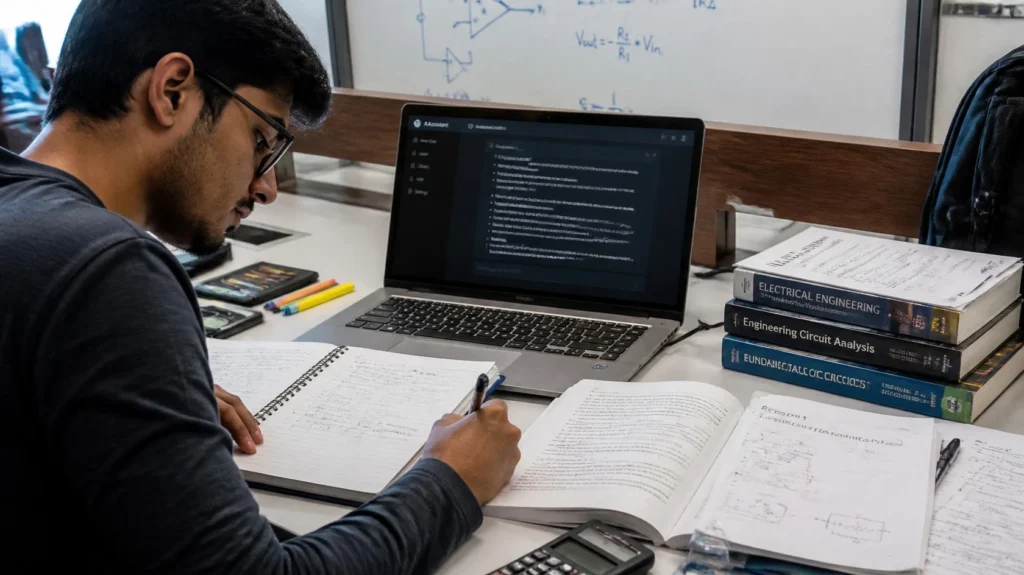
Engineering is not only about solving equations or memorizing formulas, it is about understanding how ideas connect. Have you ever looked back at your notes before an exam and realized they were full of information but lacked a clear learning path? That is exactly where a smarter review process can make all the difference, helping you transform scattered notes into meaningful knowledge.
Instead of rereading the same pages repeatedly, Review Engineering Notes can become a structured strategy that improves comprehension, retention, and confidence. By combining thoughtful note organization with AI assistance, students can spend less time searching for information and more time understanding the engineering principles that truly matter.
Reviewing Engineering Notes With ChatGPT
A successful study session begins with well-organized information. Before diving into specific techniques, it is important to understand how AI can complement, not replace, your own analytical thinking. Using a ChatGPT Study Assistant allows you to identify important information faster while keeping your learning process active and intentional.
Organizing Notes From KFU Lectures
Lecture notes often contain definitions, calculations, diagrams, and instructor explanations recorded in a short amount of time. Rather than reviewing everything equally, organize your notes by topic, chapter, or engineering discipline. This structure makes future revisions significantly easier while helping you recognize relationships between different concepts.
Identifying Key Engineering Concepts
Once your notes are organized, the next step is identifying the concepts that appear repeatedly throughout lectures. These usually represent the core learning objectives and deserve the greatest attention during revision. AI can highlight definitions, engineering principles, formulas, assumptions, and frequently discussed topics without overwhelming you with unnecessary details.
Preparing Notes For AI Review
Clean, structured notes always produce better AI responses. Separate different topics, correct obvious spelling mistakes, and remove duplicated information before submitting your notes for analysis. This simple preparation improves accuracy and allows ChatGPT to provide clearer explanations, summaries, and learning recommendations.
Using ChatGPT For Better Learning
Learning becomes more effective when information is transformed into understanding rather than simple memorization. Instead of using AI as an answer generator, think of it as a learning companion that encourages deeper thinking, asks better questions, and reinforces concepts through multiple perspectives.
Summarizing Complex Engineering Topics
Engineering subjects often contain dense explanations that can feel intimidating during revision. ChatGPT can simplify these materials into concise summaries while preserving the essential technical meaning. Albert Einstein famously said, “If you can’t explain it simply, you don’t understand it well enough.” Although often paraphrased, the principle perfectly reflects effective engineering learning, true understanding begins with simplicity.
Creating Personalized Revision Questions
Reading notes is only the beginning. Active recall strengthens long-term memory far more effectively than passive review. By generating personalized revision questions based on your own lecture materials, ChatGPT encourages critical thinking while revealing knowledge gaps before examinations.
Explaining Difficult Engineering Concepts
Some engineering topics require multiple explanations before they become intuitive. Ask ChatGPT to explain a concept using practical examples, visual analogies, or step-by-step reasoning. Viewing the same subject from different perspectives often makes difficult theories much easier to understand.
Improving AI Assisted Study Sessions
The greatest value of AI appears when it becomes part of a complete study workflow rather than a shortcut. Combining careful note review, instructor guidance, and AI-assisted explanations creates a balanced learning experience that improves both understanding and academic integrity.
Reviewing Engineering Lab Notes
Laboratory notes deserve the same attention as lecture notes because they document practical applications of engineering theory. AI can help summarize observations, organize experimental results, identify inconsistencies, and clarify technical conclusions without replacing your own analysis.
Verifying AI Responses With Faculty
No AI system should become your only academic reference. Always compare important explanations with lecture materials, textbooks, and instructor feedback. Educational researcher John Hattie emphasizes that, “effective learning grows from meaningful feedback, reminding students that verification is an essential part of genuine understanding rather than simply finding answers.”
Applying AI Responsibly At KFU
Responsible AI usage means supporting learning instead of replacing critical thinking. Students should use ChatGPT to clarify difficult concepts, organize notes, generate practice questions, and review engineering materials while maintaining academic honesty and independent problem-solving skills.
Start Learning Engineering Smarter At KFU
Every successful engineer develops a system for learning, not just a habit of collecting information. The real advantage comes from reviewing notes consistently, questioning ideas critically, and transforming information into practical understanding. When AI is used responsibly alongside classroom learning, it becomes a valuable partner rather than a substitute for knowledge.
The strongest study habits are built one session at a time. As your engineering notes become clearer and more structured, learning gradually becomes more efficient, more confident, and ultimately more enjoyable.
If you are ready to study more effectively, start using ChatGPT thoughtfully to organize, review, and strengthen your engineering knowledge today.